
Where wearable studies actually fail
An app-based virtual site only reaches the app-fluent.
ObvioHealth's virtual-site model and ObvioGo app are a real strength for digitally comfortable populations and remote capture. But every app dependency narrows enrollment and adds a failure point: participants who can't or won't manage an app drop out of the data. Delve's device integration includes cellular and non-app devices, so the wearable keeps transmitting without the participant managing software — and concierge recovers wear-time when it slips.
Bottom line: If your study population is digitally comfortable and you want an app-based virtual site with endpoint services, ObvioHealth is a capable choice. If your population is broad, older, multilingual, or low-tech, and signal quality across the whole cohort is the deliverable, Delve is the better-fitting platform.
Where ObvioHealth and Delve genuinely overlap
At the capability level, both can support a modern wearable-enabled trial. Both typically offer:
- Decentralized and hybrid trial support
- eCOA / ePRO plus sensor and wearable data capture
- Digital endpoints and digital biomarkers
- Patient engagement built around remote participation
The differences show up once you ask what happens when a participant stops wearing the device, when a sensor produces unusable data, or when an endpoint depends on validated algorithms across more than one device.
Side-by-side comparison
ObvioHealth vs Delve Health: capability comparison
The table reflects publicly documented positioning and standard delivery models for each platform. Specific configurations vary by contract.
| Capability | ObvioHealth | Delve Health |
|---|---|---|
| Signal quality & endpoint integrity | ||
| Device integration model | App-mediated capture | BYOD, provisioned, cellular & non-app |
| Reaches low-tech / non-app participants | App dependency | Yes — cellular / non-app devices |
| Validated digital-endpoint algorithms | Endpoint services + sensors | 70+ algorithms across 25+ devices |
| Signal quality control / completeness | App-based capture | Active QC layer with drift & sync detection |
| Wear-time recovery (human) | Virtual-site coaching | Concierge in 120+ languages, proactive |
| Multilingual human support | Coordinator model | 120+ languages built into platform |
| Device logistics & provisioning | Supported | End-to-end across devices |
| Per-study completion accountability | Service-driven | 92–98% documented per study |
| Compliance posture (HIPAA, GDPR, 21 CFR Part 11, GCP, ISO 27001) | Yes | Yes |
Why wearable-heavy studies pick Delve
Four reasons sponsors choose Delve when wearable endpoint integrity, wear-time, or retention is the deliverable — not the customer's problem to solve.
Completion is the deliverable
Delve publishes documented 92–98% per-study eCOA/ePRO completion ranges and up to 63% retention uplift in long-duration cohorts — platform-owned, not the customer's problem to solve.
Validated algorithms across many devices
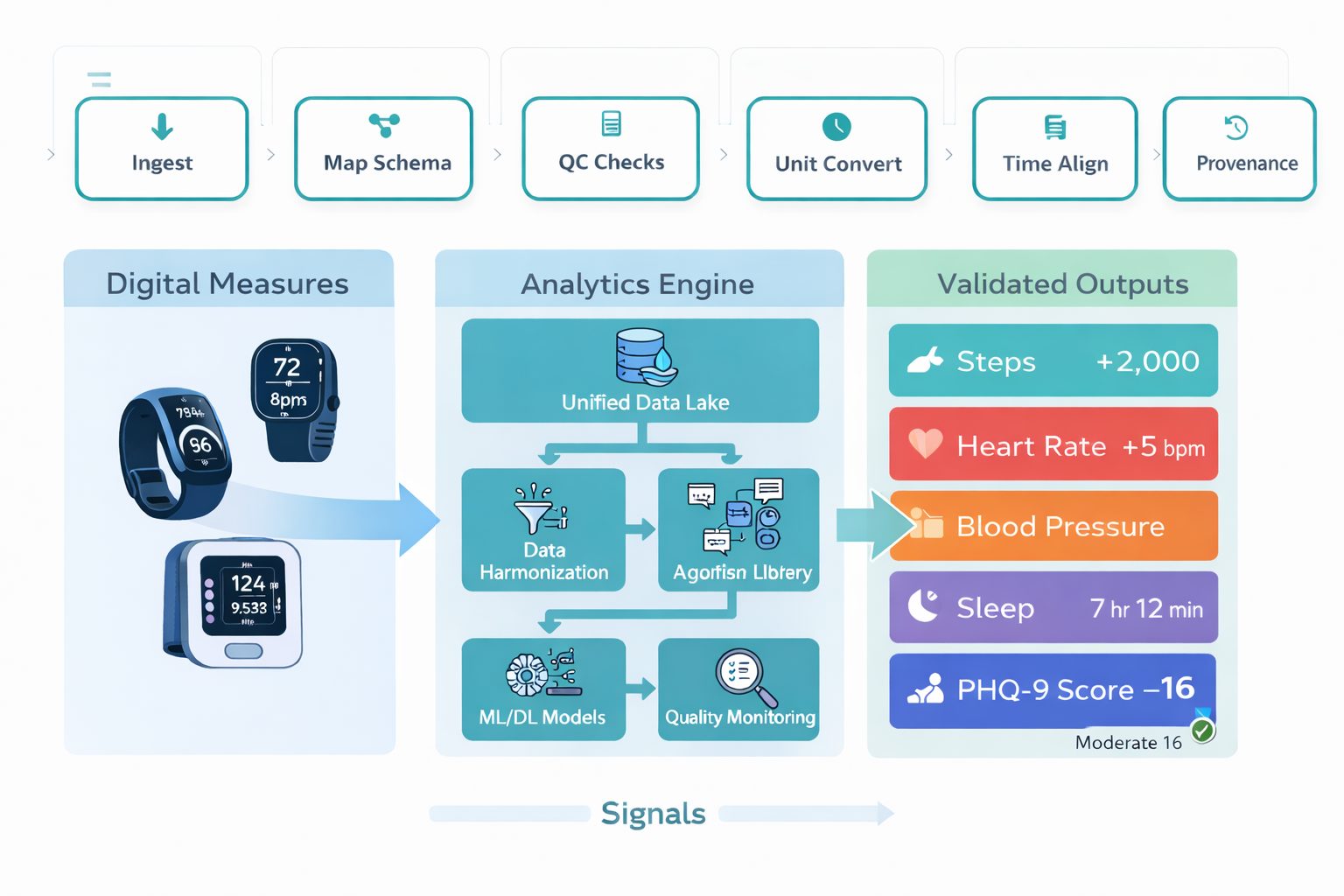
70+ validated digital-endpoint algorithms across 25+ devices on one harmonized data layer that normalizes units, sampling rates, time bases, QC flags, and algorithm versions.
Signal quality, owned end-to-end
Signal quality control validates completeness, flags drift, and catches sync failures before data is lost — not discovered at database lock.
Humans recover wear-time
Concierge-as-a-Service in 120+ languages recovers participants before wear-time decays — proactive outreach, device troubleshooting, escalation.
Which platform fits your study
Choose the platform that fits your operating model
Choose ObvioHealth if…
- Your population is digitally comfortable and app-first
- You want a fully virtual-site model with endpoint adjudication services
- Your protocol fits ObvioHealth's app-centric capture
- You prefer a single vendor-run virtual site over device-agnostic integration
Choose Delve Health if…
- Your population is broad, older, multilingual, or low-tech
- You need cellular / non-app device integration so capture does not depend on an app
- You need signal quality control and wear-time recovery across the whole cohort
- You want human concierge in 120+ languages built in
- You want documented per-study completion (92–98%)
Frequently asked questions
Questions sponsors ask when comparing ObvioHealth and Delve Health
Is Delve Health an ObvioHealth alternative?
Yes. ObvioHealth offers an app-based virtual-site DCT model with endpoint services. Delve Health offers device-agnostic wearable integration (including cellular and non-app devices), signal quality control, validated algorithms, and human concierge. Studies with broad or low-tech populations often prefer Delve because capture does not depend on an app.
Why does app dependency matter in wearable trials?
Every app dependency narrows who can participate and adds a failure point. Older, multilingual, or low-tech participants are more likely to drop out of app-based capture. Delve supports cellular and non-app devices so the wearable keeps transmitting without the participant managing software.
Does ObvioHealth support cellular or non-app devices?
ObvioHealth is built around its app and virtual-site model. Delve specifically integrates cellular and non-app devices in addition to BYOD and provisioned hardware, which widens the population a study can enroll and retain.
How do the patient-support models differ?
ObvioHealth uses a virtual-site coordinator model mediated through its app. Delve includes Concierge-as-a-Service in 120+ languages that proactively recovers wear-time and troubleshoots devices before data goes missing.
Which is better for signal quality and endpoint integrity?
Both capture sensor data. Delve adds an active signal quality control layer that validates completeness, flags drift, and catches sync failures before data is lost, which is what protects the endpoint in long or high-burden studies.
Evaluating Delve against ObvioHealth?
Ask each vendor one question: what happens to your endpoint when a participant stops wearing the device? The answer tells you more than any device list.
Book a Platform Walkthrough